Saturday, February 4, 2017

Caricaturing the Arabs: Indonesian Exceptionalism and Islamic Feminism


"We’re Muslims, but Islam here isn’t like Islam in Arabia.”

From the film Ayat-Ayat Cinta (Verses of Love, 2008): Fahri (Fedi Nuril), an Indonesian studying in Egypt, overlooks an Arab man beating and shouting at his wife in the streets of Cairo after she drops a bag of groceries. 
"Indonesian Islam represents the values of Islam that are tolerant of other religions,... accepting of local culture, compatible with the age of nation-states, and willing to work together with those of other faiths in order to strengthen the Unitary Republic of Indonesia. This clearly shows a different face of Islam from that found in the Middle East, which shows itself to be intolerant, full of violence, and bloody..."
-From the book Archipelago Islam (2015, pg. 14)
There is a dominant theme throughout much of Indonesian Islamic discourse—from casual conversation to popular media to academia—that paints Islam in Indonesia as being different from Islam elsewhere in the world. This self-identification as being distinct from, and indeed usually superior to, Islam in other countries is a mindset that I call Indonesian exceptionalism. And when casting Islam in Indonesia as exceptional (exceptionally moderate, tolerant, peaceful, egalitarian, etc.), a caricatured version of "the Arabs" is repeatedly used as the foil. Arabs are the object of uncritical stereotyping in Indonesia, and are generally painted as lacking the many virtues that Indonesian Muslims possess. This differentiation is accentuated nowhere more emphatically than in the realm of women's rights. 

It’s understandable why Indonesians would want to distinguish themselves as practicing a unique type of Islam. The images of “Islamic terror” and “misogynistic Islam” that permeate international media don’t go unnoticed by Indonesian Muslims, who then feel the need to assert that this doesn’t represent them. But rather than defending Islam as a whole from Islamophobia, the usual response is to assert that Indonesian Islam is nothing like the Islam one sees in the news—nothing like the Islam over there in Arabia.

After spending about a year in Indonesia, I have on countless occasions heard something along the lines of, “we’re Muslims, but Islam here isn’t like Islam in Arabia.” This sentiment has come up in conversations with close friends, classmates, academics, Islamic education teachers, and random people I happen sit next to on a train or at an angkringan. Naturally, as a white foreigner, I am far more likely to have this explained to me on a frequent basis, but this just shows how much this narrative is aimed at defending the image of Islam in Indonesia.

There are obviously concrete differences in how Islam functions as a social phenomenon here as opposed to elsewhere in the world. However, the point of this post is not to discuss how Indonesian Muslims actually differ from others, but rather to focus on how their own self-image paints them as being different—especially compared to Arabs. 

In order to distance Indonesian Islam from Arabian Islam, the former is painted as modern, moderate, tolerant, peaceful, and progressive while the latter is imagined to be more medieval, extreme, intolerant, violent, and misogynistic. These twin narratives—Indonesian exceptionalism and Arab demonization—manifest differently, although fairly consistently, among different Islamic factions and in different spheres of life.

Indonesian and Arabian Islam in the Indonesian imagination

The concept of an exceptional Indonesian Islam tends to be strongest among “traditionalist” Indonesian Muslims, who center their religious experiences on unique localized practices. This faction frames “tradition” as the distinguishing factor for Indonesian Islam, and they celebrate the unique local Islamic traditions that exist throughout the country (though with a dominant focus on Java), such as slawatan (see the video below), tahlilan, yasinan, reverence for ancestors, and certain types of dzikr. Nahdlatul Ulama (NU), the largest traditionalist Islamic organization in Indonesia, recently launched a campaign called Islam Nusantara, meaning "Archipelago Islam" (read: Indonesian Islam), which is portrayed as exceptionally tolerant and peaceful.

(Slawatan: An Indonesian Islamic music genre where Arabic and Javanese lyrics praising the Prophet are accompanied by a drum ensemble. Skip to 0:54 to hear the drums kick in. Skip to 1:02 to see a dude making funny faces. Skip to 2:05 to hear the language change from Arabic to Javanese.)

This image of exceptional Indonesian Islam is pitted directly against an image of Arabian Islam. In a 2015 NU-published book entitled Archipelago Islam, the writers explain that Islam in Indonesia coexists harmoniously with local cultures because "it did not come directly from the Arabian peninsula" (pg. 89). Through interlocutors in central Asia and north Africa, they explain, Indonesia received an Islam that was both tolerant of and rich with diversity. 

After these traditionalists, the second (though much smaller) contingent of Muslims in Indonesia are generally called "modernist." Represented by organizations like Muhammadiyah and Persis, modernists tend to frown upon (or condemn, in some cases) activities like NU-style slawatan that they consider pseudo-Islamic, having no basis in original Islamic texts. Although modernists are understandably less likely to insist that Islam in Indonesia is "different" in essence compared to Islam in Arabia or elsewhere, they still differentiate themselves. Just last week, a prominent intellectual in the Yogyakarta branch of Muhammadiyah told me (without being prompted), "I think Islam in Indonesia is quite different from Islam in the Middle East. Here, I think the majority is moderate; tolerance is pretty good." 

(Disclaimer: the characteristics of contemporary traditionalism and modernism in Indonesia are not necessarily reflective of what the terms might intuitively suggest. I use these terms here for the sake of simplicity and to stick to popular usage. For more on differences between groups and factions within Indonesian Islam see Bruinessen 2013. There are also other factions of Islam in Indonesia, but when discussing mainstream Islamic discourse, those within the families of traditionalism and modernism still dominate.) 

While Indonesians often proudly emphasize the vast diversity of religious life in their country, the Arab world is frequently portrayed as a monolith. What I have been rendering as "Arabian Islam" is the vague term Islam di Arab (Islam in Arab). In Indonesian, Arab can also be the name of a place, sometimes meaning Saudi Arabia, sometimes meaning the entire Arab world, and most often with the speaker not being aware of or concerned about the difference between the two (much like the use of "Arabia" in English). The imprecision of this term contributes to Indonesians' monolithic image and wide misunderstanding of the Arab world. For example, one can say, "In Arab, women aren't allowed to drive," and the listener could reasonably assume that this applies to Egyptian, Algerian, and Emirati women as well. But even aside from issues related to Islam, per se, Arabs are generally stereotyped as angry, violent, and unable to control their emotions. 

Just like in America, most respect for nuance goes out the window when talking about the Arab world. Because ISIS cuts off people's heads, and because ISIS is centered in "Arabia," ISIS's brand of Islam has come to represent Arabian Islam in the minds of many Indonesian Muslims. A line in Archipelago Islam matter-of-factly refers to Islam in the Middle East as "intolerant, full of violence, and bloody" (pg. 14).

The irony here is that both Islamic factions mentioned above largely employ approaches to Islamic knowledge and practice that were developed by Arabs (and some Persians). Traditionalists refer mostly to the great scholars of the Islamic golden ages, and are generally said to follow the kalam (theology) of Abu Hasan al-Ash‘ari (an Arab), the fiqh (jurisprudence) of Muhammad al-Shafi‘i (an Arab), and the sufism of Abu Hamid al-Ghazali (a Persian). Modernists, on the other hand, trace their intellectual heritage back to the Islamic reformist movement of the late 19th and early 20th centuries and hold great respect for Jalaluddin al-Afghani (a Persian), Muhammad ‘Abduh (an Arab), and Rahid Rida (an Arab). Needless to say, all Indonesian Muslims also revere the Prophet Muhammad (an Arab). Despite this common respect for historical Arabs (and even many contemporary Arab scholars), these are not the figures that dominate narratives about and caricatures of "Arabian Islam." It's as if there's an Arab intellectual elite that commands the respect of Indonesian Muslims, but these Indonesians have somehow conceptually dissected these scholars from the societies in which they live(d). 

Most Arab Muslims refer to these same Islamic scholars and texts. But there is a widespread misconception in Indonesia that Wahhabism is the dominant stream in the Arab world (which, again, makes sense if we mistake it with Saudi Arabia alone). "Wahhabi" becomes erroneously synonymous with "Arabian Islam" in general, and it is now generally used as a vague pejorative to disagree with anyone a bit more conservative or purist than you. Traditionalists, for example, will frequently subtly imply that modernists are Wahhabis. (On the historical nuances of the relationship between Islamic modernism, Salafism, and Wahhabism, see this fantastic book by Henri Lauzière.)

Women's rights as a rhetorical battleground 

One of the most frequent ways Indonesians distinguish their Islam from Arabian Islam is through the language of women's rights. Given dominant western and international narratives that  claim Islam to be a misogynistic religion, Indonesians tend to respond by asserting that any perceived misogyny is just a remnant or product of Arab culture. In his book, Teologi Feminisme Islam, Syarif Hidayatullah writes:
"...we can draw a firm line between the perspective of the Qur'an and the biases of the culture that surround it. This makes clear the difference between the true Islam of the Qur'an and the Arabized form of Islam—which offers a patriarchal understanding of gender that discriminates against women. This patriarchal and discriminatory interpretation has gone on for centuries without the realization of the Islamic ummah, to the point where they valorize pre-Islamic Arab traditions that completely reject the equal role and status of men and women." (pg. 60)" 
He then goes on to explain the brutality of pre-Islamic Arab culture towards women, and contrasts that with the respect women are granted by Islam. 


 At a university seminar in Yogyakarta last November, young scholar and kyai Irwan Masduqi offered a similar explanation. The Qur'an, he explained, was meant to liberate women, but then "ulama over there in Arabia" created misogynist interpretations by incorporating aspects of their own culture, like the myth that a woman's libido is seven times greater than man's, which led to sexual repression. He then went on to talk about how Indonesian female migrant laborers in the Middle East are typically treated poorly and sexually abused. 

These explanations do not deny the discrimination and oppression experienced by many women in Indonesia—they simply blame it on the Arabs. Misogyny is never approached as an issue of local cultures in general, but of Arab culture in particular. Indonesians, absolved of any agency in the process, are portrayed as simply the inheritors of misogynist Arab-made interpretations.

Above, Syarif Hidayatullah and Kyai Irwan are participating in intellectual Islamic feminism, a movement that exists mostly in academia and some parts of civil society. But the act of comparing women's rights in Indonesia and Arabia is popular far beyond this intellectual discursive sphere. 

Narrative on screen: Indonesian and Arabian Islam as portrayed in Verses of Love (2008) 

Ayat-Ayat Cinta (Verses of Love, 2008), directed by Hanung Bramantyo, is a Indonesian commercial film that, upon it's release, became the highest grossing Indonesian film of all time. The plot centers on Fahri (Fedi Nuril), an Indonesian student studying at the Islamic university Al-Azhar in Cairo, and it depicts his interactions with Arabs, fellow Indonesians, and other foreigners. The film is a very unsubtle depiction of Indonesian stereotypes, and employs many of the characterizations of Arabs mentioned above. 

Throughout the film, there are few Arab characters portrayed positively. On the contrary, Fahri is consistently valiant, patient, and kind. As a result, multitudes of women fall in love with him and see him as the perfect Muslim man. 

In one scene, Fahri sees an Arab man scream at and beat his wife in the street after she drops a bag of groceries (see screenshot at the top of the page). As they walk away, we see the woman gaze at Fahri helplessly. In another scene, another Arab man begins to shout at a niqabi woman (who we later learn is named Aisha) who gave up her train seat for an elderly American tourist, who the Arab man calls a "kafir" and blames for the deaths of Muslims in American wars." The man raises his fist to punch Aisha, but Fahri steps in to explain that Muslims must be fair and follow the sunnah of the Prophet. The Arab man then punches Fahri and walks away yelling "Allahu akbar." Aisha looks at Fahri longingly, and when they meet again later she tells him, "I rarely meet a muslim like you" (read: "all the Arabs I know are angry and intolerant"). On another occasion, Fahri saves an Arab woman (Nurul) from her abusive father and so she also falls in love with him, saying "you are truly a man with great morals." Later, we watch Aisha gaze longingly at Fahri as he cites the Qur'an to explain why Muslim men shouldn't beat their wives. 

From Ayat-Ayat Cinta: Aisha (Rianti Cartwright) gazes longingly at Fahri as he stands up to the angry Arab man on the train.
Throughout the film, Fahri is the heroic depiction of the imagined Indonesian Islamic ethic. He is the ideal Indonesian Muslim man, the perfect imam. And our hero repeatedly meets his foils in angry, misogynist Arab men. Indonesian women viewers are clearly supposed to be thankful that their husbands are Indonesian, not Arab.

It's worth noting that not all popular media depicts Arabs this way. The angry, misogynist, and violent traits of Arab characters were especially emphasized in Ayat-Ayat Cinta mainly because it served as a plot device. On the other hand, in another film about Indonesians studying in Cairo, the two-part Ketika Cinta Bertasbih (When Love Reads God's Name, 2009) by Chaerul Umam, I noted no negative portrayals of Arabs whatsoever. It is also common to use oppressive husbands as foils for protagonists in Indonesian Islamic cinema, such as in Tenggelamnya Kapal Van Der Wijck (The Sinking of the Van Der Wijck, 2013), by Sunil Soraya, in which a drunk, unsupportive husband is cast against another loyal and loving man. But in keeping with Indonesian exceptionalism, the antagonist is westernized while the protagonist is an Islamic scholar.  

Also, while Arabs' bear the brunt of stereotyping, other ethnicities can be lumped in with them for being vaguely Middle Eastern as well. In the two-part 99 Cahaya di Langit Eropa (99 Lights in Europe's Sky, 2013 & 2014) by Guntur Soeharjanto, a Pakistani character is easily angered by racist comments of a white character, whereas the Indonesian male Muslim protagonist is consistently calm and charismatic in the face of Islamophobia. (Again we see the parallels with western demonization of not only Arabs or muslims, but of anyone who might looks like them as well.)

Tenggelamnya Kapal Van Der Wijck (2013)
Ketika Cinta Bertasbih (2009)
99 Cahaya di Langit Eropa (2013)
(I refer to the above films as "Islamic cinema" because they all infuse romantic or dramatic plots with religious themes. Or in the case of 99 Cahaya, the plot is explicitly about religion.)

A theme among all these male Muslim Indonesian protagonists is that they embody the virtue of being sabar, or patient. To be sabar in the face of adversity (or someone just being an asshole) is one of the most valued traits in Indonesian (and especially Javanese) culture. These similar male characters in Indonesian Islamic cinema both contribute to and demonstrate the supreme importance of kesabaran (the noun form, patience) to both the producers and consumers. On the other hand, male Arab characters in Indonesian cinema, while occasionally not being portrayed as unrestrained monsters, are never written with the supreme virtue of being sabar. 

Global narratives on Islam, misogyny, Arabia, and Indonesia

This narrative of the exceptionally moderate/tolerant/peaceful nature of Indonesian Islam has gained traction outside of the country as well. In a 2015 clip from CNN that went viral on Facebook and Twitter, Reza Aslan responds to claims that Islam is misogynistic by pointing to Indonesia (among other countries) as a sort of utopian counterexample to "Iran and Saudi Arabia." At one point, Aslan even proclaims that, “[in] Indonesia, women are absolutely, 100% equal to men.” Granted, CNN anchors Alisyn Camerota and Don Lemon were saying some pretty ignorant and Islamophobic things, but many of Aslan’s responses are simplistic and erase/ignore the experiences of actual women. I know plenty of Indonesian feminist activists who would be happily out of a job if women were in fact “absolutely, 100% equal to men." 

(Aslan mentions Indonesia at 2:35 and 5:30)

On one hand, this incident shows how neglected Indonesia is in the field of Islamic studies. Aslan is not alone in his ignorance; Indonesia is regularly plucked out as an example of a “free, tolerant, peaceful Muslim society” whenever that description suits the narrative of some scholar or journalist who has otherwise spent little to no time in the country. On the other hand, this interview reflects the dominant narrative of an exceptional Indonesian Islam, which has by now gone international.

And if Westen observers agree with the narrative that Indonesian Islam is completely tolerant and egalitarian, then they certainly agree also that this is an exception to Islam elsewhere, most notably in Arabia. 

The lasting weight of colonial feminism 

It is impossible not to note how these Indonesian narratives mirror and interact with Western stereotypes about Islam and Arabs and their supposed misogyny. The term "colonial feminism" was introduced by Leila Ahmed in her book Women and Gender in Islam (1992). In it, she writes:
"The idea that Other men, men in colonized societies or societies beyond the borders of the civilized West, oppressed women was to be used, in the rhetoric of colonialism, to render morally justifiable its project of undermining or eradicating the cultures of colonized peoples..."
In our case, Indonesians clearly don't seek to (nor are they in the position to) "undermine" or "eradicate" Arab culture. What we are dealing with here is not colonial feminism per se, but inherited colonial feminism. Indonesians have been exposed to western colonial feminist discourse that paints Islam as misogynist. Their response: rhetorically carve themselves out as exceptional from the rest of Islamdom and then point an eager finger back at their fellow Muslims. Just like imperialism co-opts feminist rhetoric, Indonesian Islamic discourse often adopts the language of feminism simply to demonize Arabs and Arab culture. While real feminism values the rights and wellbeing of women, colonial feminism and its inheritors demote these goals to mere symbols in an inter-civilizational spitting match. 

Thursday, December 8, 2016

On Leftism and Love

Not only is a fighting faith possible, but it may in fact be the most effective vehicle for bringing us closer to a prosperous world. 


Every once in a while I am overcome by the realization that the highest form of good I can achieve in my life is to love unconditionally. On the rare occasions when I see this truth clearly, I am taken aback and frankly ashamed of how rarely I am conscious of this ideal. In far too few of my interactions with fellow humans does my heart "burn with loving kindness" (as my Baha'i friends like to say) for everyone I interact with.

I genuinely believe (though rarely remember) that all minor objectives that are worth fighting for in life boil down to this single objective of unconditional love. But don't get me wrong; in our current political and social environment, love cannot be just an escape from oppression but a confrontation of it. Obviously, we do need love in itself in times of hardship, but no, love is not all we need. We also need resistance. We also need organization. We also need vocal and relentless dissent to fascism, bigotry, and all their ugly cousins. This is because we need good schools and good jobs and good healthcare, and we need them to be equally accessible for everyone.

But as I see it, at the end of the day, these goals are still all simply stages and prerequisites to achieve the overarching ideal of love.

When all progress is achieved: a thought experiment

Imagine a world where "progress" succeeds. Obama's "baton" is indeed repeatedly handed off in a relay of socioeconomic progress until, some day, the anchor crosses the finish line. Fukoyama is finally redeemed; history is over. Equality is a social fact. The ghost of Tomi Lahren is uncomfortably quiet because the PC left is no longer “whining.”

Granted, this type of vision of future hardly seems imaginable right about now; I don't know about you, but some of my basic presuppositions about history, progress, and the future of humanity have recently been shaken pretty hard. But, despite the likelihood that there will always be certain groups dominating and exploiting others (or that climate change will lead to a future without humanity), engaging with this imaginary utopia can help us contemplate what our most basic values really are.

I do think it's reasonable to assume that there could be a set of conditions that, if achieved, would render the idea of continued social progress incomprehensible. I obviously can't claim to know what a perfect world / utopia would actually look like—though if you asked me now, I might say something along these lines: the provision of quality education and healthcare to all people in the world; the elimination of all forms of systemic and personal discrimination; the elimination of poverty. Clearly the content of the conditions themselves is subject to debate, but our working assumption here is that there are—in the abstract—conditions that would fulfill requirements for "utopia."

So once those "created equal" are actually treated equally, what's next? We'd guess that a strict Marxist would essentially retire. If our end-game is defined by material conditions alone, then there’s nothing left to fight for. Even more contemporary socialists, who incorporate more than money and capital into analysis of power relations, would basically have their cause solved at this point. They could essentially just sit back and enjoy utopia.

In my mind, however, the next frontier must be altruism. Once we've learned not to value certain fellow humans over others, the goal posts should naturally shift to not even valuing ourselves over fellow humans. Just like the utopia itself, I am not claiming that this widespread altruism is actually achievable, but it is certainly an ideal that can be approached.

The alternative to this vision of altruism would be an individualistic and hedonistic leftism, where the ultimate goal would be to create a world in which people had equal opportunity, but in which the common person felt no individual responsibility to maintain the wellbeing of their fellow humans. I believe that this would bring us to a world where we are indeed equal but not fully prosperous.

In this context, prosperity is not complete with just economy or physical well being (as this would obviously already be achieved in our imaginary utopia). Instead, by prosperity, I mean the realization of communities of people that are happy, fulfilled, and have support from loved ones. To achieve this kind of prosperity, we would need to love each other, nurture and support each other, encourage creativity, embrace difference, and welcome excellence in all its forms.

Love as a goal

As I see it, this prosperity would be built through a culture of altruism. The principles of this altruism would need to be founded on mutual love. Practically, this type of mutual love is most readily found in religious belief systems.

To create a fully prosperous world would necessarily require altruism. Altruism, in allowing us to care about the welfare of others as we would ourselves, enables the creation of social support networks that go beyond the limits of narrow self-interest. If we were willing to make minor sacrifices so that others could make major gains—a fairly frequent condition—we would logically be able to collectively accomplish much more.

This type of altruism would be enabled by love as a motivating factor. As Freud said, “At the height of being in love the boundary between ego and object threatens to melt away”—i.e. love creates altruism. This love would be conceptualized in the form of universal human solidarity. The limits of this solidarity would need to surpass most existing models like tribalism or nationalism, which still find some humans to designate as Other. While history is rife with examples of those who were altruistic for the sake of their particular group, only truly universal love would transcend all boundaries. (Let’s take another moment to remember that while this is realistically an unachievable ideal, in pinpointing that ideal we may attempt to approach it.)

Ultimately, the greatest potential for building such an ethos of universal love lies in religious belief. Despite the current weakness of most faith-based leftist movements (on which more later), faith-based traditions are rich with radical political ideas, calls to altruism, and messages of unconditional love. In Matthew 19:21, Jesus preached that “If you want to be perfect, go, sell your possessions and give to the poor." I would even include humanism under the umbrella of “religious belief” (on the condition that it finds a way to command the type of dedication that historically only religion, tribalism, and nationalism have); indeed, Voltaire wrote, “Every man is guilty of all the good he did not do.” Only in such a morally demanding belief system—regardless of whether we find in it origin stories and the Almighty—do we find the means capable of engendering a culture of mutual love that can open the door to widespread altruism.

Love as method

If love is our (ultimate) goal, then I think it’s worth briefly discussing the role and importance of love as a method towards reaching that goal. As a means to achieve the egalitarian, prosperous, and loving world we strive for, we can’t forget to be loving along the way as well. The Dhammapada reminds us that “hatred does not cease by hatred at any time: hatred ceases by love, this is an eternal rule.”

While this sentiment clearly sounds nice, there are also concrete ways in which this principle manifests in current social struggles. Research shows that if we actually want to reduce bigotry, in most cases the most effective way to do so is not by calling people out for being bigots, but by constructively engaging with these people and reminding them of the humanity and inherent dignity of all people. (Obviously, the burden of such patient engagement should fall primarily on the shoulders of allies rather than the targets of bigotry themselves.)

While the role for love in the realm of interpersonal relationships is fairly evident, it may be harder to employ when dealing with larger structural issues. Certainly, we should not even imagine that indigenous Americans would have been able to disrupt construction of the Dakota Access Pipeline through reasoned appeals to the government. Here though, we can remember that aggressive, harsh action is often required, but that doesn’t require us to hold hatred towards any person. In Gandhi’s description of “the devotee” (which I hope he would not object to us equating here with “the activist”) he calls them “versed in action and yet unaffected by it.” This detachment and commitment to love is certainly not necessary for an activism—hate towards oppressors has undeniably accomplished tons historically—, but I personally believe it to at least be beneficial to the activist themself. 

Opening the Door to Faith-Based Resistance

On the night of the presidential election, Brookings scholar Shadi Hamid wrote on Twitter, “We need a fighting faith,” lamenting the impotency of political liberalism in the face of fascism [my wording]. This criticism realistically extends to secular leftism as well. We forfeit a large amount of rallying potential when we abandon the concept of Truth. If Truth doesn’t exist, we’re left with moral relativism, and in a world where what’s right is completely subjective, then is any of this really worth all the fuss?


Of course, there have been and there are fighting faiths. Liberation theology in Latin American saw Christ as a revolutionary figure. Gandhi rallied millions with his concept of Satyagraha, a social movement explicitly grounded in a Truth-claim. Ali Shariati wrote of “Red Shi’ism” and conceptualized tawḥīd as a liberating ideology.

Despite the historical prevalence and success of fighting faiths, they are currently undeniably weak. I see this situation as based on a few different factors. First off, Marx calling religion an “opiate” was certainly not helpful to the spread of his ideas among the passionately religious. Recent history has also frequently pitted these groups against each other, with the Cold War positioning the Godless socialists against the God-fearing capitalists (which may in itself happen to be an inheritance from that momentous statement from Marx). At an American domestic level as well, however, moneyed interests were working to forge a Christian creed of libertarianism in order to fight unions and the welfare state. As a result, the reality we all live in is one where, ironically, to have faith is rarely to fight. And even if it is, fighting for one’s faith is almost always seen as fighting for one’s religious identity—defending Islam from Ahok’s “blasphemy”—and far less frequently includes a struggle for the ideas of justice and equality essential to religious teaching. What we are left with is the widespread impotence of religion in the field of social progress.

But alas, this essay strives to emphasize that not only is a fighting faith possible, but it may in fact be the most effective vehicle for bringing us closer to a prosperous world.

Yes, there are plenty of leftists (me included) who do not consistently manifest this ideal of unconditional love. Neither do the majority of religious people (again, me included). But in forgetting that love is (can be? should be?) both the foundation and the aspiration of these two projects, we sell short each of their potentials.

Post-script: reflections

I wrote this with two audiences in mind: the left and the religious.

As for the left, this is certainly not an attempt to convert secular leftists into any specific religious stream of thought. It is, however, a call for contemplation about what our basic values should be and how we can effectively spread and socialize these values.

As for the religious, this is indeed an attempt to convert people of faith to the left. In my reading of most faith traditions, I find abundant support for radical political ideas and the rejection of hedonism, materialism, and even capitalism. Except in the case of those few who take a religiously-principled quietist stance, I generally believe that most religious non-radicals would be radical (in the good way, obviously) if they reflected honestly about what their faith demands of them.

Evidently, I am far more zealous about politics than religion.

Monday, October 10, 2016

Dating and Piety among Indonesian Muslim Youth

How do young Indonesian Muslims date? How does dating relate to piety?

I have found this topic fairly difficult to write about given its intimately personal nature. It is hard to make generalizable claims from such subjective data (human experience in its most emotional state), so I feel that I genuinely lack the knowledge and authority to write most of what follows. Additionally, in analyzing dating culture, I am putting the experiences of myself and close friends under an unusually personal and uncomfortable microscope. That being said, if I have written anything that is inaccurate or misleading, or that directly conflicts with your own personal experiences, please let me know.

Regardless of difficulties and limitations, I also find this to be an important topic that deserves to be written about. Discussions of Islam and culture outside of scholarly literature rarely reach past discussions of extremism and terrorism. But if we care about studying Islam as a social phenomenon—and not just as it relates to politics and security issues—then we need to look at the many other myriad issues in which Islam intimately penetrates the lives of Muslims who are living it.

While studying abroad in Tunisia in 2014, I saw a culture that largely frowned on dating. Instead, the first openly acknowledged step in a romantic relationship was usually engagement to be married. Tunisians would inquire about others' relationship statuses not by asking whether they had a boyfriend/girlfriend, but by asking whether they had a fiancé(e). There were rumors of a former study abroad student who had gotten engaged with a Tunisian woman just so that they would be allowed to go out together and hold hands in public. While this attitude is partially attributable to local Tunisian Arab and middle class culture, it was also often explained to me by citing that "dating isn't allowed in Islam."

Similarly, although dating was fairly common among the Muslim community at my alma mater in the United States, students' relationships were usually kept secret. Understandably, privacy was seen as appropriate for private relationships, but this was also driven by a fear of the judgement of other students. As in Tunisia, this secrecy was obviously partially influenced by group dynamics and the unique cultural backgrounds of different students, but it was also certainly influenced by common legal and ethical readings of Islam that discourage dating.

But regardless of whether pre-marital romantic relationships among Muslims are called "engagement" rather than "dating" in Tunisia or whether they are kept secret from fellow Muslims on American college campuses, the fact remains that these romantic relationships do exist.

But before living in Indonesia, I was never exposed to a community of Muslims that not only dated, but did so openly and unabashedly. When living in a boarding school in Aceh (a province with a reputation for being especially "Islamic"), I was shocked to find that late high school students (in a rural area) were dating at a rate that I gauged was similar to American high school students and that their parents were usually aware and not overly disapproving of these relationships.

Indonesian dating culture

After witnessing this phenomenon during my time in both Aceh and Java, I decided to make it the focus of my final project for the CLS Indonesian summer language program in Malang. This involved carrying out interviews with students at the State University of Malang about their experiences, aspirations, and opinions about dating in Indonesia. As a result, I can offer a general (and vastly oversimplified) picture of how dating works in Indonesia (at least among typically middle class university students).

Indonesian relationships start with a process referred to as PDKT (short for pendekatan, or "getting close"). This relationship phase is not expressed as an official status, but rather corresponds to the situation where an American student might explain, "we've just been hanging out." Similarly, PDKT is vague, has no guarantee of leading to a formal relationship, and can last as long as a few months. 

PDKT is usually (though certainly not always) initiated by the man who gives (not-so-)subtle signs to the woman (I sincerely regret that as a result of my experience and access, I can only attempt to describe heterosexual relationships). These signs usually involve showing his care (perhatian) for her, which is usually demonstrated by frequently asking frivolous questions, such as "have you eaten/bathed/prayed yet?" or "are you sleepy/exhausted/bored?" These inquiries demonstrate that the well being and comfort of his crush (gebetan) are of concern to him. (These questions serve the function of the American "how are you?" or "what's up?" in that the response—almost always "good" and "not much," respectively—is not as important as the question itself having been asked.) Another characteristic of the PDKT phase is "venting" (a poor and less emotive translation for curhat, which is short for curahan hati or "pouring [one's] heart out") to each other. In a culture that discourages complaining about one's problems, mutual curhat helps signal the intimacy (abnormality, non-public-ness) of a relationship. 


Eventually, PDKT is followed up by formal dating (pacaran), in which the man and woman make a commitment to each other, are referred to as boyfriend/girlfriend (pacar), and—necessarily—express their love for each other. In Indonesian relationships (unlike in the vast majority of American ones), the word "love" (cinta, sayang, kasih) is used as soon as a couple formalizes a relationship, and its use is in fact a crucial part of the process of solidifying that relationship. (To any Indonesian readers, American couples rarely say "I love you" until at least a few months into the relationship.) Once this relationship is official, the couple participates in similar activities like those enjoyed by American couples; they eat together, go to the mall or the movies, and just hang out. (I cannot comment on the sexual lives of Indonesians. Although nearly no one admits to having sexual relations outside of marriage, when asked about the sex lives of others, most Indonesians say it is fairly prevalent.)

Not only is dating prevalent in Indonesian youth culture, but it has become a norm to the point where being single is (lightly) stigmatized. In most social groups in Indonesia, to be chronically single (jomblo) is a point of shame and can lead to becoming the butt of friends' jokes. Being jomblo is not just to be single, but to seem to be unable to attract a parter. As the popular proverb goes, "single itu pilihan; jomblo itu nasib" ("being single is a choice; being jomblo is fate").

See this Saykoji song that makes fun of Indonesian men who are jomblo:

The stigmatization of being jomblo is affected by two main cultural forces (among others). The first is prevalent homophobia. When not having a significant other can bring suspicions of homosexuality, there is an even greater shame associated with being jomblo and hence an even greater incentive to not be seen as jomblo. The second is the pressure on Indonesians (particularly women) to get married. A woman who is not married by her late 20s or a man who is not married in his early 30s will typically endure a barrage of pressure from friends and (mostly) family. To be jomblo is to be another (seemingly unreachable) step away from achieving this goal.

But what about Islam?

Now, the above description of dating practices and attitudes among Indonesian Muslim youth may reasonably beg the question: what about Islam?

I have neither the interest nor the expertise to cite Islamic jurisprudential or ethical scholarship concerning pre-marital romantic relationships. What is interesting, however, is that in most other cases I am familiar with outside of Indonesia, consciously pious Muslim communities are not as accepting of dating, and—significantly—they base at least part of this position on Islamic teaching.

This line of thought exists in Indonesia as well, but it simply isn't very popular. Certain stricter groups have opposed the prevalence of dating on the grounds that they see it as un-Islamic. While they are a minority in the overall Indonesian Muslim community, these groups have been vocal with campaigns like #IndonesiaTanpaPacaran ("#IndonesiaWithoutDating") to discourage young people from dating. Instead, they encourage them to adopt the practice of taaruf (from the Arabic تعارف for "getting to know [each other]"). As with most uses of recent Arabic loanwords in Indonesia(n), the use of taaruf connotes Islamic-ness (as opposed to PDKT, which notably has a similar denotation). Advocates of taaruf suggest that young Muslims get to know each other with marriage as the explicit goal, which should take place as soon as possible after compatibility is recognized. Any prolongation of the pre-marital relationship is seen as frivolous and as risking zina (extra-marital hanky-panky). These groups have even tried to redefine the narrative around jomblo, like in the slogan "jomblo sampai halal" ("stay single until it is permissible [marriage]").


It is important to understand the social position of these stricter groups and avoid the common mistake of using terms like "strict," "conservative," and "pious" interchangeably. It would be inaccurate to call them "conservative" as, although they are resisting cultural change, they are also demanding cultural change in the implementation of new practices like taaruf. It would also be a mistake to valorize them as somehow more "pious" that other Indonesians, although this is how they largely conceive of themselves. Among other Indonesian Muslims, however, the piety of these stricter groups can be seen as largely performative [sok taat] and not recognized as being a somehow more genuine way to practice Islam.

In Indonesia's Islamic mainstream, dating is largely seen as a cultural fait accompli and those who date are not necessarily seen as committing any sin (given they avoid zina). Outside of those aforementioned stricter groups pushing for taaruf, most opposition to dating is framed in non-doctrinal terms and is almost entirely focused on its practice among children seen to be too young. While a small minority may lament the poor religious state of Indonesians Muslim youth because of the prevalence of dating, this is not the mainstream view.

More importantly, average Indonesians are not rejecting these strict approaches on secular grounds; rather, they are asserting that this is too strict of an interpretation/application of Islam. They are not saying that Islam should not affect the private social sphere, but instead that Islam does not object to this particular private social activity. In other words, they are maintaining their conscious piety while defending dating as an Islamically acceptable social phenomenon. I remember a maulid (celebration of the Prophet's birth) ceremony at a boarding school where an Islamic preacher told the students to wait before starting to date—not on the grounds that it was un-Islamic, but because they should focus on school and pleasing their parents and that dating should come later. In a sermon that explicitly concerned how to be a good Muslim, this preacher maintained that there was in fact an appropriate place for dating.

A note on ascriptive vs. observational approaches to issues of Islam and culture

What does Islam say about dating?

Instead of trying to answer this question, I would much rather talk about the assumptions implicit in it. The above takes as a given that there is a singular "Islam" that can indeed say things. If approaching the issue through the mindset of a consciously pious believer and practitioner, this obviously must be assumed in order to come to an applicable legal or ethical conclusion. From the perspective of faith, even though there may be a plurality of interpretations, there still is an Islam that does say things.

However, if we want to approach the issue of dating as social scientists, these assumptions—and the analytical paths they lead us down—do little to help us to understand dating as a social phenomenon. In the social sciences, we should not approach Islam as a monolithic entity that has a fixed set of rules and positions on specific issues, as this external analytical imposition of our own interpretations (or selections of certain Muslims' interpretations) can blind us from the lived actual experiences of Muslims and the diversity of interpretations that they themselves develop. If we simply accepted the premise that Islam disapproves of dating, that would tell us nothing about how to understand the very real romantic lives of young Indonesian Muslims.

While this discussion may seem somewhat trivial when talking about an issue like dating, the same lesson applies to matters of greater political and social consequence as well. When a pundit asks, "Is Islam compatible with democracy?" they adopt this same unfortunate assumption that there is a singular, monolithic Islam that indeed says something about democracy. This can (and usually does) lead us to forgetting that there are actual Muslims who say things about democracy as well, and that perhaps their words are more important. Political commentators far too often turn directly to the Qur'an for answers about Islam, ignoring the social reality of Islam that is constituted by Muslims themselves. Likewise, when talking about counterterrorism, it is far less useful to have a comprehensive knowledge of early Islamic discourse on jihad than it is to know how modern Muslims actually understand the concept.

This abuse of text and disregard for lived experience and contemporary thought is the (pseudo-)intellectual fuel of the Islamaphobia movement. The ability to point out instances of violence in Islamic texts without having to engage with progressive Muslim discourse on those passages allows bigots to portray not just Islam, but also Muslims as derivatives of it (which is, of course, all orientalism sees Muslims as being) as violent and threatening.

I think it is appropriate to conclude with this sentiment from Abdelwahab El-Affendi:
Despite the achievements of scholars who have followed the sunnah (tradition) of Max Weber in using religion to explain social phenomena, it remains risky for social scientists to double as amateur theologians, especially when they want to speak in a prescriptive mode. This need not discourage us from dabbling in theology, as long as we remember that theology and political sociology are profoundly different enterprises. The greater risk is not that theology will corrupt social science, but the reverse. Social scientists have a dangerous tendency to take such theological concepts as “the rule of God” at face value and then run away with them—projecting, for example, simplistic contrasts with the political concept of “the rule of man.”

Saturday, September 10, 2016

To Profit from Neither Capital nor Labor: Economic Culture in Indonesia

Indonesia's parking system and the culture of street performance seem unreasonable. But while these phenomena may not follow capitalist logic, they do make sense. 


As an American living in an Indonesian city, I regularly find myself in situations where I am expected to pay someone who, in my estimation, has not provided me with any services warranting my payment. When I hand money to parking attendants or street performers (pengamens) in Yogyakarta, I often find myself questioning whether they deserve my money. But this begs a fundamental question: who deserves money, and from whom, and when, and on what grounds?

I (along with most Americans) am accustomed to a dominant economic mindset in which payment is only necessary (and hence, deserved) on two conditions:
  1. a transfer of labor for money, when the recipient of my payment provides me with a service or good, like when I pay for a sandwich or for a band to play at my birthday party; or 
  2. a transfer of capital for money, when the recipient of my payment is the owner of capital that I use, such as when I pay for parking at the mall or rent a car.
In Indonesia, there is certainly an abundance of circumstances in which payment is accompanied by one of these conditions. (I regularly buy people's labor in the form of food, and I rent capital in the form of a room in a boarding house.) However, there are also numerous situations in which I find myself paying someone who—from an American capitalist perspective—doesn't deserve that money. 

Street Performers and Parking Attendants

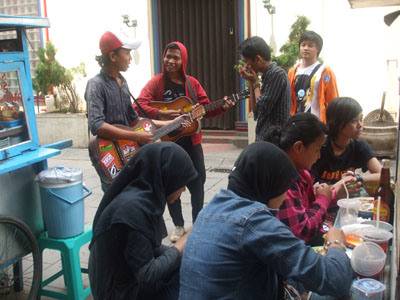
If I eat dinner at a small roadside restaurant in Yogyakarta, I usually have three expenses: the price of the food I purchase, token change for however many street performers happen to stop by my table that night (around $0.07 each), and the fee given to a motor bike parking attendant (either $0.07 or $0.15). While purchasing food makes complete economic sense to the American mind, the latter two expenses do not fit the above mentioned capitalist conditions necessitating payment. Obviously, there are parking fees and street performers in America as well, but the social norms and economics of these phenomena are remarkably different in Indonesia.

In Indonesian, someone who sings or performs in public for money is called a pengamen. In America, a street performer usually stays in one spot (like a sidewalk or a subway station) and receives money from those walking by. An Indonesian pengamen, on the other hand, roams around the city playing in a succession of restaurants and requesting money from customers. They most often perform in groups of around three or four, but a lone pengamen is not a rare sight either.

The most evident difference between pengamens and American street performers is that, in Indonesia, you are not actually paying for them to play music or even to show that you appreciate their music; you are, in fact, almost always paying for them to go away. This reality is understood by both the pengamens and those who pay them. When a pengamen stops by someone's table, they will wait as long as it takes for at least one person at that table to put some small bills or coins into their cup, and then they will immediately proceed to the next table. In all my time in Indonesia, I have only once witnesses a customer ask and pay for a performance to continue. This is partly because the music being performed often is neither enjoyable nor intended to be enjoyable. A pengamen can even be just a single person unenthusiastically shaking a tambourine.

In America, a street performer's income is usually related to their skill and the quality of their music, as their payment can essentially be viewed as an exchange for services. This is not at all the case in Indonesia. The more irritating a pengamen is, the quicker people generally are to pay them to leave, meaning they often make more than their highly skilled counterparts. This system of street performance in Indonesia is clearly not based on a transfer of payment for the provision of services.

A group of young men working as pengamens approach people eating at a roadside stall

Payment for parking is similar. At almost any small retail or food venue in a city where someone dismounts from their motor bike, they will be expected to pay a parking attendant a fee of either one thousand or two thousand rupiahs, equivalent to $0.07 and $0.15 respectively. But a parking attendant is rarely affiliated with or employed by the establishments he works in front of, nor does he own the land that he charges people to park their bikes on. They are simply men (parking attendants are always men, and I have never seen an exception) who wear orang jackets and sit on stools watching over one or more parking areas. A common explanation is that these men are affiliated with a gangster (preman) who gives them the exclusive right to work their territory, but I have no ability to confirm this or to say how often this might be the case.

While these parking attendants clearly aren't the owners of the capital (parking space) that you are using, there is still the element (though often just the illusion) of a services-for-payment exchange. These attendants are responsible for people's helmets not getting stolen, although I've never heard of a friend having their helmet stolen after parking in a lot not guarded by an attendant. Also, when pulling out into the road, he will walk a few yards into the street, blow his whistle, and motion for cars and other bikes to slow down and give you room to pull into the street and merge into the flow of traffic. When traffic is heavy, this can be somewhat of a convenience, but merging one's bike onto a crowded street is something an Indonesian with a motor bike does countless times every day without any assistance. What's more telling is that even when the road is completely empty, the parking attendant will usually still go through the same motions of helping—or at least appearing to help—you pull out onto the street.

A man in a typical parking attendant outfit

What's interesting about both street performers and parking attendants is that there is at least the facade of an adherence to capitalist standards of payment. A parking attendant goes through the motions of seeming like he is helping you pull onto the street even if that's actually no help at all. On the surface, this is a services-for-payment exchange, but in reality, the service is of little to no real value. Similarly, a pengamen who simply shakes a tambourine until you pay them has no intention of providing a desired service (i.e. enjoyable music) to a restaurant customer, but as long as they have an instrument in their hands, there is the illusion that those paying have somehow benefitted from the interaction.

Social Welfare and Indonesian Culture

So why do Indonesians spend money to get nothing in return on such a regular basis? Clearly, there are material factors that play into these phenomena; vague rumors abound of drivers who refused to pay parking attendants and were subsequently threatened by a local gangster. In the case of paying a pengamen, when the music is unpleasant, I absolutely benefit by paying for it to stop.

But there are also social and cultural factors that seem to play an even larger role. I often ask my Indonesian friends why parking attendants and pengamens are entitled to their money. Most express frustration with having to pay them (the money may seem insignificant to an American, but when a quality meal can be found for around $0.50, paying $0.30 for parking and two rounds of pengamens can increase the cost of a meal by 60%), but they also mention that this is how parking attendants and pengamens make a living. Without these payments, most of my Indonesian friends remind me, they would be unable to support their families.

This sense of communal responsibility for the welfare of others is a sentiment held by plenty of people around the world, whether proponents of state-led socialism or the private charity system. However, there are certain elements of Indonesian culture promoting such an outlook that may partially help explain general attitudes towards parking attendants and pengamens.

In post-colonial Indonesia, political and social rhetoric emphasizes the corrupting influence of Dutch rule and the tranquil and symbiotic communality of the primordial Indonesian ethos. Regardless of whether or not this utopia ever existed, this communal spirit has become a prominent theme in Indonesian nationalist discourse. The concept of gotong royong (originally from the Javanese for "communal work," but possibly now better translated as "mutual assistance") is especially notable. When Indonesians engage in gotong royong, they gather within a community organization (whether a village, a school, or a neighborhood) and contribute labor to a common cause, whether cleaning a road or constructing a badminton court. While paying a parking attendant or pengamen seems to be the exact opposite of gotong royong (they profit without labor, rather than labor without ), it is representative of the ethics of the idea: fellow Indonesians are brothers and sisters (saudara) and share a duty to help one another.


It is also worth noting that Indonesians place especially high value on being ikhlas, which in Indonesian includes the meaning of being selfless and detached from whatever losses one suffers. It is likewise impolite to lament one's own misfortune. This ethic is held strongly in Indonesian culture and certainly affects attitudes towards paying a parking attendant or pengamen, but perhaps even more powerful is the social pressure that results from the expectation to be ikhlas. Payment to a pengamen always takes place on a social stage, when friends, families, or couples are eating out together, and this can result in social pressure to appear ikhlas and not stingy (pelit).

Between Capitalist Logic and Human Need

Indonesia's official unemployment rate is not high; it was calculated at 5.94% for 2014. However, an estimated 55 to 65 percent of Indonesian workers are employed in the informal sector. This means that there isn't necessarily an abundance of formal jobs, but that—as anyone who lives in the archipelago can attest to—Indonesians are extremely enterprising and manage to find a multitude of ways to profit off of whatever labor they can provide in whatever setting is available. But non-salaried workers can struggle to get by in the informal sector, with an estimated 11.2% of Indonesians still living below the poverty line (which hardly accounts for urban poverty by being set at around $22.60 per person per month).

In this kind of economic environment, where finding stable work is difficult for those without educational credentials, there are a significant amount of Indonesians who are in need of more money in order to live comfortably. Since labor for which actual demand exists seems to be limited, it makes sense that those trying to make money would move into fields of labor for which there is no real demand as long it can bring home income. Because of the cultural power of compassion and social pressure explained above, and since the Indonesian government has shown little ability to stop unofficial parking attendants from collecting fees (they have tried), these unhelpful industries can become profitable for those who get involved.

Ultimately, parking attendants and pengamens rarely provide needed or desired services to those who pay them, but this activity provides an income for those who need it. This approach does not protect or prioritize the needs of the consumer, but rather the needs of the laborer. This may be considered inefficient from a macroeconomic standpoint as it devotes resources to unproductive activity, but it would be hard to argue that parking attendants and street performers (and their families) would be better off without this source of income, at least in the short term.

From another perspective, these phenomena resemble an unofficial form of economic redistribution to the lower class. An Indonesian who frequently eats out and own a motor bike is not necessarily wealthy, but they probably have more economic stability than most parking attendant or pengamens. In a context where the state is fairly neoliberal, this represents somewhat of a (small) culturally enforced social welfare system. This is distinct from charity, in which one chooses to contribute money for no personal benefit; rather, it more closely resembles the tax system in which participation is mandatory, even though this tax is levied by social constructs rather than the state. (Parallels could be drawn to the Islamic zakat system, which is more tax than charity, although not run by a state.)

A similar struggle between the neoliberal state and a cultural system that promotes social welfare is currently on display in the debate over public transportation in Jakarta. Earlier this year, Jakarta governor Ahok proposed to eliminate small transport vans called angkots in an effort to decrease traffic and transition to the more modern TransJakarta bus system. This was met with praise by some for reducing economic and transportation inefficiency, but there has also been a strong backlash emphasizing that the policy would result in the unemployment of thousands of angkot drivers, leaving them and their families with no source of income.

Angkots in Jakarta

Who Deserves Money?

In America, when a difficult economic environment creates a dire need that neither the government nor private charities can fill, people often have to resort to begging on city streets to stay alive. In Indonesia, it is remarkable that beggars consist almost entirely of the elderly, small children, and women with babies. Aside from the fact that these groups tend to evoke the most sympathy from passersby, this also suggests that anyone who is capable of doing something other than begging is expected to do so in order to earn money.

It is not abnormal to see people dressed up in costumes at intersections walking between stopped cars to ask for money. These people don't necessarily seem to intend to entertain people in the cars, but by wearing a costume they are doing something. By simply doing something, their activities can still be considered work, rather than begging, and this preserves the dignity of the person in need of money.

As we are currently in the midst of Dhu'l-Hijjah, this attitude is highly reminiscent of the actions of Hagar upon which many of the rituals involved in the Hajj pilgrimage are based. Thirsty and left in the desert with her infant child Ishmael, Hagar had faith that God would not abandon them. However, she still ran back and forth seven times between the mountains of Safa and Marwa searching for water, only to discover the Zamzam spring producing water right where she had left Ishmael. Hagar's actions in themselves did not directly result in her and Ishmael's salvation, but she knew that to be worthy of God's grace, she needed to at least do something.


An artistic depiction of Hagar and Ishmael.

Likewise, contemporary Indonesian culture seems to dictate that in order to deserve something, one must do something (if physically able, as noted by the exceptions for the elders, mothers of infants, and children, for whom it is acceptable to beg). By maintaining the facade of providing a service such as entertainment or helping drivers pull into the street, Indonesian parking attendants and street performers deserve to be paid because they are doing something.

This system does not maximize value for consumers, but it does provide for the wellbeing of a fraction of the poor and their families while still maintaining their dignity. Parking attendants and pengamens may be resented by some Indonesians, but at least they are not seen as lazy. The same can't be said about neoliberal attitudes towards the poor in America.